Moses and Pharaoh in History

In Cecil B. Demille's classic "The Ten Commandments" starring Charlton Heston, Yul Brynner plays the role of Pharaoh Ramesses in one of the all-time great Bible movies about Moses. But according to the Bible, Ramesses could not have been the Pharaoh of the Exodus.
The reason many movies about Moses portray the Pharaoh as Ramesses is because of the Bible passage found in Exodus 1:8-11 which states:
"Now there arose a new king over Egypt, who did not know Joseph. And he said to his people, "Look, the people of the children of Israel are more and mightier than we; "come, let us deal shrewdly with them, lest they multiply, and it happen, in the event of war, that they also join our enemies and fight against us, and so go up out of the land."
“Therefore, they set taskmasters over them to afflict them with their burdens. And they built for Pharaoh supply cities, Pithom and Raamses."
The Bible says that the Israelites built Raamses, and since Ramesses the second, who began his rule around 1290 B.C., built a royal city named Pi-Ramesses, many just assume him to be the pharaoh of the Exodus.
But the Bible never specifically identifies the pharaoh of the Exodus by name, although it does tell us the exact date of the Exodus.
1Kings 6:1 states that Solomon began building the Temple in the fourth year of his reign, 480 years after the Exodus. The temple was started in 1012 B.C., which was derived by adding up all the years that the Judean kings ruled including Solomon, and adding that number to 587 B.C., the date the last king ruled in Jerusalem at its destruction by Babylon.
The calculation is as follows: Total reign of the Judean kings & Solomon = 434 years x 360 days, a Biblical year/365= 428 + 587 B.C. = 1015 B.C. the beginning of Solomon’s reign. The temple was started in the 4th year of his reign which would be 1012 B.C.
Bishop Usher also calculated 1012 B.C. in his work "Annals of the World” way back in 1650 A.D.
So the approximate date of the Exodus can be calculated: 1012 B.C. + (480 years x 360 days, a Biblical year/365) = (1486 B.C.). And according to history, Pharaoh Ramesses did not begin his reign until around 1290 B.C., so he couldn't have been the Exodus pharaoh.
Depending upon which history book you read, there are four possible candidates. They being Thutmose I, Thutmose II, Hatshepsut, and Thutmose III.
Scholars disagree as to the exact dates that they ruled and the length of their reigns which makes it difficult to pinpoint the exact one. To get some clues, let's look at what the Bible says about the events surrounding the life of Moses.
The first place we will start is with the date of his birth. Exodus 7:7 states the following:
"Moses was eighty years old and Aaron eighty-three years old when they spoke to Pharaoh."
Adding 80 years to the date of the Exodus in 1486 B.C. equals 1565 B.C.; the approximate year in which Moses was born.
Again, there are four possible rulers of Egypt who ruled around this time frame. They were Senakhtenre Ahmose, Seqenenre Tao, Kamose, and Ahmose.
To get our first clue, we will start with the Bible’s statement in Exodus 1:8 which says that a king had come to power who knew not Joseph and began to oppress Israel. Joseph as you recall was second only to Pharaoh during his days and was put in charge of building grain storage and supply cities in order to make it through the seven years of famine. This practice evidently continued even after Joseph's day. One of the supply cities mentioned in Exodus 1:11 is Raamses. There is a city in early Egyptian records named Avaris, which later was annexed and became part of Ramesses II royal city of Pi-Ramesses. A branch of the Nile river passed through Avaris and it had a port for the loading and unloading of supplies for use among the other cities along the Nile.
The interesting thing about Avaris was that it was a major city of the “shepherd kings” whom some refer to as “Hyskos” while others refer to them as “Asiatics.” You see Joseph brought his father Jacob and his brothers, who were shepherds, into the land of Egypt and they were given the land of Goshen in which to raise their flocks. Pharaoh also made them the chief herdsman over all his livestock.
They basically were allowed to live independently in Goshen as subject to Joseph, who was second only to Pharaoh. After Joseph died this arrangement continued. Israel had their own rulers in the land of Goshen subject only to Pharaoh. And the capital of their kings appeared to be the supply city of Avaris, which later became part of Raamses.
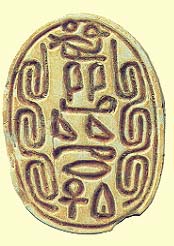
One really neat artifact found from one of these shepherd kings was a scarab with the words "Jacob-El" which can be translated as "Jacob's God.” This confirms their relationship as being descendants of Jacob (Israel).
Our next clue comes in Exodus 1:10 which says this Pharaoh was worried about Israel joining with Egypt’s enemies to fight against them.
An inscription from the reign of pharaoh Kamose matches this statement exactly. It states: “The mighty king of Thebes, “Kamose” . . . His majesty went to his palace and sat down among the council of the Nobles . . . He said to them, Where is my strength? One prince is in Avaris while the other is in Ethiopia. I sit associated with an Asiatic (Hebrew) and a black leader. Each one of them has their own slice of Egypt. (The Israelites to the north, while the Ethiopians controlled the most Southern part of Egypt.) I cannot keep from coming across them as far as Memphis, the waters of Egypt, they have Hermopolis. No Egyptian can settle in the land without coming into contact with the Asiatics.”
Then the nobles of the council spoke saying: "Behold it is Asiatic water as far as Cusae, and they have not spoken ill against us. Whereas we are at ease in our part of Egypt. Elephantine is strong and the middle of the land is with us as far as Cusae. The sleekest of our fields are plowed for us, and our cattle are pastured in the Delta. He has not stolen any of our cattle. He holds his land, that of the water basin, and we hold Egypt. If he would ever come and act against us then we will act against him.”
Their words offended the Pharaoh and he said: "As for this plan of yours . . . He who divides the land with me will not respect me.” . . . “I shall sail north and fight against the Asiatics and be successful . . . says Kamose the protector of Egypt. I went north because I was strong enough to attack the Asiatics.” . . . “My soldiers were as lions are with their spoil, having slaves, cattle, . . . dividing all their property." ANET 232
Another inscription from the reign of Kamose may refer to Pharaoh’s command to kill all the Hebrew baby boys, it states: “My army is after you, the women of Avaris will not conceive, their hearts will not open within their bodies . . . Avaris in the two rivers. I shall leave it a desolation . . . I captured a messenger, of the ruler of Avaris, who was headed to Cush with a letter (asking for help) saying . . . "Have you not seen what Egypt has done to me . . . attacking me on my own soil although I have not attacked him, just like everything he has done to you. Come quickly he is in our hands. I will detain him until you arrive. Then we shall divide the towns of this Egypt, and our two lands will be happy in joy . . . But I captured the letter on its way and did not let it arrive.” ANET 554-555
So the actions of Kamose definitely appear to match with the actions of the Biblical pharaoh who started the persecution of the Hebrews.
The Bible then indicates from this point onward that the children of Israel were afflicted by future pharaohs with slavery until God would deliver them by sending them Moses. And history records this to be so. The next pharaoh after Kamose was Ahmose. An inscription from one of his military commanders states the following: “There was fighting on the water at Avaris, I captured ten and carried away a hand . . . Avaris was then attacked and despoiled. I personally carried off spoil of my own, one man and three women whom my majesty gave to me as slaves." ANET 233
The slavery and the brutal practice of soldiers under Ahmose’s command cutting off one of the hands of the Israelite’s in order to bring them before pharaoh in exchange for gold as a reward shows the hatred and severe persecution which he inflicted on the people dwelling in Avaris.
According to the Bible, in Exodus 1:22-2:10, Pharaoh gave the command that every son who was born of the Hebrews should be cast into the river. So fearing the child's life, the mother of Moses hid him in a basket in the reeds along the bank of the Nile. While Pharaoh’s daughter was walking along the riverside she found him and raised him as her son.
Although the Bible never records her name, the Jewish historian Josephus writing in the first century does. He states:
"Pharaoh’s daughter, Thermuthis, was walking along the river bank. Seeing a basket floating by, she called to her swimmers to retrieve it for her. When her servants came back with the basket, she was overjoyed to see the beautiful little infant inside . . . Thermuthis gave him the name Moses, which in Egyptian means “saved from the water" . . . Having no children of her own, she adopted him as her own son."

The Hebrew word for Moses is “Mosheh,” taken from the Hebrew word “Mashaw” (maw-shaw) meaning to draw out. In Egyptian, it probably is the combination of the words “Ma-Sah.” “Ma” meaning “water” and “sah” which means “to draw near to” or “to succeed in acquiring to reach land from the water.”
Another possibility are the Egyptian words ‘Mes-sah.’ “Mes” meaning “born, son, child, or baby” and “sah” meaning “drawn from the water to land.”
Josephus says that the name of pharaohs’ daughter was "Thermuthis" and there was a princess of Egypt who had a very similar name who lived during the 1565 B.C. time frame. Her name was “Ahmose-Tumerisy.” She was probably the daughter of pharaoh Seqenenre Tao and the sister of pharaoh Ahmose I. She held the title of "king’s daughter" and "king’s sister.”
The historian Eusebius also seems to indicate this. He calls pharaohs’ daughter “Merris,” a shortened form of the name “Tu-MERIS-y.”
After Moses had become a man, the Bible in Numbers 12:1 says that he married an Ethiopian wife, whom he probably married while in Egypt. It states: "Then Miriam and Aaron spoke against Moses because of the Ethiopian woman whom he had married; for he had married an Ethiopian woman."
Although the Bible doesn’t say how they met, the historian Josephus does:
“When Moses reached his manhood, there was a great battle fought between the forces of Egypt and Ethiopia in which the Ethiopians were victorious. And they set out to conquer all of Egypt. Their armies invaded the land of Egypt as far as Memphis and the Sea. The diviners and oracles that the Egyptians consulted urged them to make Moses the commander of Pharaoh’s army. And so they did so.
Moses, in his first battle, made a surprise attack on the Ethiopians and they were defeated. They then began to flee Egypt while Moses followed them all the way back to their own country in order to engage them in battle.
In the end, they retreated to Saba, the Capital of Ethiopia. . . . When Moses had punished the Ethiopians, he gave thanks to God and celebrated his marriage to Tharbis, the king of Ethiopia’s daughter, who had fallen in love with Moses.“
For many years modern historians laughed at the idea that Ethiopia could have been strong enough at this time to almost conquer Egypt. But in 2003 an inscription was found on a tomb at Elkab detailing a massive invasion of Egypt from the combined armies of Kush along with its allies from neighboring lands.
Many cities along the Nile were indeed ransacked by the Ethiopians for their treasures. And some believe that if the Ethiopians had stayed in those cities and had not just ransacked them, they could have indeed conquered all of Egypt.
The next significant event which occurs in the life of Moses is when he flees the land of Egypt after killing an Egyptian. Moses was 40 years old at this time according to Acts 7:23-29 which says:
"Now when he was forty years old, it came into his heart to visit his brethren, the children of Israel. And seeing one of them suffer wrong, he defended and avenged him who was oppressed, and struck down the Egyptian . . . Then Moses fled to Midian.”
Adding 40 years from the date of his birth in 1565 B.C. equals 1525 B.C., the date at which he flees Egypt. The pharaoh at that time was probably Amenhotep I, who also accounts engaging the Ethiopians in battle.
That leaves us with who was the pharaoh of the Exodus.
Josephus wrote: "The Pharaoh, from whom Moses had fled, died, and a new Pharaoh had become ruler. Moses traveled to his palace and told him of the victories he gained for Egypt in the war against Ethiopia . . . He also spoke to Pharaoh about what had taken place on Mount Sinai, and when Pharaoh laughed, Moses showed him the signs."

One possible clue as to whom the Exodus pharaoh may be comes from an inscription from Queen Hatshepsut. She mentions that she was rebuilding a temple in Avaris, from where we mentioned earlier the shepherd kings ruled.
The inscription states: “The boundary of those who are herdsman dwelling in the midst of the Nile Delta, in the city of Avaris, foreigners, the shepherd people are in the midst of them. Therefore, overthrowing our father's rule, their posterity did not acknowledge Re. They were blind to my father’s divine commands.”
Just like the Bible says of the Hebrews, the inscription mentions Avaris (Raamses) as being inhabited by foreign shepherds who were also herdsmen over pharaoh’s cattle.
From her statement, it appears that Israel was in Egypt, down to or right before her reign. So this would indicate that either her father Thutmose I or her husband Thutmose II with whom she co-reigned as queen, would be candidates for the Exodus Pharaoh.
Another really interesting thing about this inscription is the possibility that the hieroglyphic symbols on the inscription may also be translated in a way that could mention the Hebrews passing through the parted sea running from chariots.
The part of the inscription which is typically translated “Foreigners, the shepherd people, in the midst of them,” can also be translated just as easily as “Sea runners, the shepherd people, in the midst of them (the waters of the sea).”
The reason being is that the hieroglyphic symbols for ‘foreigner’ is the Egyptian word sh-mamu. But when broken down separately into two words, ‘sh’ and ‘mamu.’ ‘Sh’, which is represented by a rectangular box in hieroglyphics is the symbol for a ‘body of water, lake, sea, etc.’ And the symbol ‘mamu’ is the word used for runners, like those in the infantry who ran alongside the chariots of the Egyptian army. Very interesting indeed.
Another inscription from Thutmose III, who co-reigned along with Hatshepsut, may also indicate that the Israelites had left Egypt before his time.
In a hymn he wrote speaking of the power of his god, Amon-Re, he states: ”It plunders numerous foreign peoples and consumes those dwelling in the swamp. Its flame cuts off the heads of the herdsmen and defeated his children, returning the scepter from the herdsmen’s mighty ones.”
So it appears that either at his time, or just before, there was no Israelite remaining in the marsh areas of the Nile Delta.
According to the Bible, after the ten plagues that God sent against Egypt, Israel departed, but Pharaoh led his army in pursuit of them at the Red Sea. The Bible records the following:
"So the Egyptians pursued them, all the horses and chariots of Pharaoh, his horsemen and his army, and overtook them . . . And when Pharaoh drew near, the children of Israel lifted their eyes, and behold, the Egyptians marched after them. So they were very afraid, and the children of Israel cried out to the LORD . . . Then the waters returned and covered the chariots, the horsemen, and all the armies of Pharaoh that came into the sea after them. Not so much as one of them remained." Exodus 14:23-28
The Bible also says in Psalm 136:13-15: "To him who divided the Red Sea asunder, and brought Israel through the midst of it, but swept Pharaoh and his army into the Red Sea."
These passages seem to indicate that Pharaoh was killed in this event.
So since Hatshepsut and Thutmose III both state in their inscriptions that they lived at a time when the Hebrews were no longer in Egypt, this would exclude them from being the pharaoh who died in the parting of the Red sea incident. Although they would have been alive growing up in the house of the two previous pharaohs to witness the plagues on Egypt and the Exodus first hand.
Therefore, that leaves either Thutmose I or Thutmose II as possible candidates.
Unlike Hatshepsut and Thutmose III who said no Asiatic remained in Egypt, Thutmose I indicates the Hebrews were still in the land during his life. He states: “He who smites the Nubians and overthrows the Asiatics . . . From the marshes of Kebeh ( near Heliopolis) to Elephantine. The sand dwellers bore their tribute like that made from the south (Ethiopia) and that of the North (Asiatics/Hebrews).”
Thutmose I also had a son by the name of Amenmose who was his eldest son and designated heir to his throne. Yet he predeceased his father, possibly in the firstborn plague. He also had another daughter named Nefrubity who also seems to have died very young. This and the fact that the mummy, of what was once identified as Thutmose I, is no longer considered to be his, gives a high probability that he is the Exodus pharaoh. For if his mummy is missing, this could possibly account for his death in the Red sea, while the mummies of all the other pharaohs who lived during the Exodus time frame have been found.
Although it is important to note that if one reads Exodus 14:30 carefully it states the following: "So the LORD saved Israel in that day out of the hand of the Egyptians, and Israel saw the Egyptians dead on the seashore." This passage indicates that the dead bodies of the Egyptians were deposited on the shore of the Red Sea. This would have allowed the Egyptians access to his body for burial.
As for Thutmose II, the other Exodus candidate, it is interesting to note that although his mummy has been found, it was covered with scabs which may be physical evidence of the boil plague that God had sent upon Egypt.
Although we have no inscription mentioning Asiatics within Egypt during his reign, an inscription from one of his military commanders mentions taking “very many living prisoners of the Shasu.” The Shasu being a generic term for “bedouin shepherds,” which may or may not have been Hebrew.
Thutmose II also had two children, a son Thutmose III, who became Pharaoh, and a daughter, Neferure, through his marriage with Hatshepsut. Neferure lived into the reign of Hatshepsut. So since it appears that both his children lived past his death and one of them would have been his firstborn, it appears that this would eliminate him as the Exodus pharaoh, unless of course he had other unknown children whose records have yet to be found.
So in summary it appears that either pharaoh Kamose or his father Seqenenre Tao began the persecution of Israel, and Moses was born either in their reigns or that of Seqenenre Tao's other son, Ahmose I. The pharaoh’s daughter who adopted Moses appears to have been “Ahmose-Tumerisy” and the pharaoh from whom he fled was Amenhotep I. With the most likely candidates for the Exodus pharaoh being either “Thutmose I” or “Thutmose II.”
LIVE BY FAITH IN THE LORD:
"By faith Moses, when he became of age, refused to be called the son of Pharaoh's daughter, choosing rather to suffer affliction with the people of God than to enjoy the passing pleasures of sin, esteeming the reproach of Christ greater riches than the treasures in Egypt; for he looked to the reward.
By faith he forsook Egypt, not fearing the wrath of the king; for he endured as seeing Him who is invisible." Hebrews 11:24-27
HUMBLE YOURSELF BEFORE THE LORD AND HE WILL LIFT YOU UP!
"Now the man Moses was very humble, more than all men who were on the face of the earth." Numbers 12:3
A HUMBLE BIBLE STUDY:
Psalms 18:27, Psalms 25:9, Psalms 149:4, Proverbs 3:34, Proverbs 11:2, Proverbs 29:23, 2Chronicles 7:14, Isaiah 29:19, Daniel 10:12, Zephaniah 3:12, Romans 12:16, 1 Peter 5:5-6, James 4:10

This article on Moses and Pharaoh in History is taken from our 4 volume book series "Bible Believer's Archaeology" which can be downloaded for your ebook reader by visiting our resource download page by Clicking Here.
Read Next Chapter - Balaam, son of Beor
Sources used in compiling data and illustrations for this article:
Photo Links to Artifacts:
 Hatshepsut's mention of no Asiatics left in Egypt
The Holy Bible, Author: The Lord God. Scripture is taken from the New King James Version unless noted.
Artwork: ‘Moses Breaking The Tables of The Law’ Illustrated in “Art and Music - Childcraft Volume 13" (1939) Publisher: Quarrie Corporation.
Artwork: “Moses before Pharaoh” Illustrated in “The Child’s Bible being a Consecutive Arrangement of the Bible" (1884) Author: Dr. J.H. Vincent, Publisher: Cassell and Company.
Artwork: “Pharaoh’s Daughter finding Moses” Illustrated in “Battle Against Isolation” (1944) Author: Walter Johnson, Publisher: University of Chicago Press.
Biblical Archaeology Review, Sept/Oct 1987 pg.42 Pi-Ramesses occupied 19-17th centuries B.C.
"Annals of the World (1650) James Usher" - Bishop Usher calculated 1012 B.C. for the beginning of the construction of Solomon’s Temple and 587 B.C. for the destruction of Jerusalem by the Babylonians.
Biblical Archaeology Review, Jan/Feb 1988 - The Scarabs of Jacob.
Ancient Near Eastern Texts Relating to the Old Testament with Supplement, Author: James Pritchard ISBN: 0691035032 Third edition 1969. pg.232 Kamose war against Avaris. Pg 233 Ahmose war against Avaris.
pg.554 Kamose statement that women will not conceive in Avaris. pg.231 Hatshepsut mentions that the earth has carried off the footprints of the Asiatics from Avaris. Speos Artemidos Inscription.
Josephus The Essential Writings, Author: Paul L. Maier. ISBN 0-8254-2964-1. Pg.48-57 (The name of the daughter of Pharaoh was Thermuthis, and the life of Moses.)
Antiquities of the Jews - The Historian Flavius Josephus. Book 2 Chap. 9 ( Moses & Thermuthis), Book 2 Chap. 10 ( Moses in Ethiopia)
Eusebius of Caesarea: Praeparatio Evangelica (Preparation of the Gospel) Translated by E.H. Gifford (1903) - Book 9 Chapter 27, Eusebius quoting from Artapanus in his book “Concerning the Jews” says the daughter of Pharaoh was named “Merris. This sounds very much like “Tu-Meris-y.” He says Merris was buried at Meroe. www.tertullian.org/fathers/eusebius_pe_09_book9.htm
Between Two Worlds: The Frontier Region Between Ancient Nubia and Egypt, Author: Laszio Torok Pg. 109 Tomb at Sobeknakht governor of ElKab found in 2003 which mentions a massive invasion by Cush and its allies into Egypt.
Ancient Records of Egypt, The eighteenth Dynasty. Author James Henry Breasted. pg.8 Ahmose inscription mentions a southern invasion that went as far north as Tintto-emu (Tynt-t-mw) “She of the land of the water supply” which would be the Nile river delta just north of Memphis. Pg.13 Ahmose Karnak Stela says: “The Asiatics approach with a fearful step together, standing at his judgement hall. pg. 42 Thutmose I inscription mentioning the Asiatics, from the marshes of Kebeh to Elephantine. (Note: Kebeh-Hor was situated near Heliopolis while Kebeh-Set was located in Elephantine, close to the southern border of Egypt. Source: The Sacred Magic of Ancient Egypt, the Spiritual Magic Restored. Author Rosemary Clark. pg. 50 Thutmose II inscription mentioning the Shasu captives being taken prisoner. Pg.125 Hatshepsut’s Speos Artemidos Inscription makes mention of Asiatics in Avaris as being the Egyptian word (sm-mw) or (s-mw) under “note d” pg.264 Thutmose III mentions that there is not a remnant of Asiatics left.
Rhind Mathematical Papyrus mentions an attack on Sile (Tjaru) “Tell Habau” during the reign of Ahmose.
Biblical Archaeology Review Sept/Oct 1981. Avaris (Tell el-Daba) or (Khatana) hieroglyphic (R’-mtnu) similar in pronunciation with Raamses.
Halley's Bible Handbook, Author: Henry H. Halley. ISBN 0-310-25720-4. pg.111-113 Egypt's Pharaohs and their reign, pg.113 Tombs of the Egyptian pharaohs.
The Revell Bible Dictionary, Fleming H. Revell Company, ISBN 0-8007-1594-2. pg.781 (List of Egyptian Pharaohs.)
The Life and Times of Joseph in the Light of Egyptian Lore. Author: Henry George Tomkins. pg.93-104 Mention of Jacob-El and Joseph-El. On List: 5 Spring of Shasu, 99 Dibon, 102 Jacob-El, 101 Kerak, 102 Jacob-el, 103 Gebath, 104 Gezer, 110 Beth Shean, 78 Joseph-El.
Article: Radiocarbon-Based Chronology for Dynastic Egypt by Christopher Bronk Ramsey, Michael W. Dee, Joanne M. Rowland, Thomas F. G. Higham, Stephen A. Harris, Fiona Brock, Anita Quiles, Eva M. Wild, Ezra S. Marcus and Andrew J. Shortland - In Science 18 June 2010: Vol. 328 no. 5985 pp. 1554-1557
Notes on the Egyptian name of Moses: The Bible says clearly in Exodus 2:10 the name was given to Moses by his Egyptian Mother because she drew him out of the water. Moses = Original Hebrew Scripture = Moshe (mo-sheh) taken from the Hebrew word Mashaw (maw-shah)
Possibility #1: English (Collection of Water, sea, lake, etc.) = Egyptian (ma,mi,mu) pg.280 Vol.1
English (to draw near to, to succeed in acquiring to reach land, to land from a boat, to acquire) = Egyptian (sah) pg.638 Vol.2. Therefore ma-sah meaning (Water drawn, or drawn from the water) This, I believe probably matches best as to the Scripture.
Possibility #2: English (born, child, son, baby) = Egyptian (mes or mess) pgs.321-322 Vol.1. English (to draw near to, to succeed in acquiring to reach land, to land from a boat, to acquire) = Egyptian (sah) pg.638 Vol 2. Therefore mes-sah meaning (son drawn from the water).
Source for the above Egyptian words: 'An Egyptian Hieroglyphic Dictionary’ (2 Volumes) by Sir E.A. Wallis Budge (Keeper of the Egyptian and Assyrian Antiquities - British Museum), Publisher John Murray - London 1920
Speos Artimidos Inscription of Hatshepsut: Literal Translation of the Speos Artimidos Inscription by John Argubright: tcher ( boundary) (pg.908) + un = (those who are) (pg.164) + aamu = (Herdsman) (pg.111) + m-qeb or m-qab = (In the midst of the circuit of the delta.) (pg.266) Note; this symbol represents northern half of Egypt, the delta swamp. + Avaris = (Avaris city symbol) Note: the three hill symbol at the end of the name symbolizing a foreign country (city under control of foreigners) + sh-mamu = (foreigners) (pg. 741) + shepherd symbol & man symbol & and three ticks = (Shepherd men or shepherd people) + m-qab = (In the midst of the circuit) (pg.266) + sen = (of them) (pg.673)
Simplified Translation: "The boundary of those who are herdsman dwelling in the midst of the Nile Delta, in the city of Avaris, foreigners, the shepherd people, in the midst of them (Avaris or the Nile delta.)
Another possible translation using the same hieroglyphic symbols is as follows: Literal Translation of the Speos Artimidos Inscription by John Argubright: tcher (boundary) (pg.908) + un = (those who are) (pg.164) + aamu = (Herdsman) (pg.111) + m-qeb or m-qab = (In the midst of the circuit of the delta.) (pg.266) + Avaris = (Avaris city symbol) + sh = (pool of water, lake, sea, etc) pg 720 + mamu = (runners) pg.274 with shepherd symbol & man symbol & and three ticks referring to Shepherd men or shepherd people + m-qab = (In the midst of the circuit) (pg.266) + sen = (of them) (pg.673)
Simplified Translation: The boundary of those who are Herdsman dwelling in the midst of the Nile Delta, in the city of Avaris. Sea, runners, who were the shepherd people, in the midst of them. (Possibly referring to the waters of the sea.)
The Poetical Stela of Thutmoses III, Possible reference to the Hebrews (Aamu) of the Nile delta marshes being defeated by Thutmose III god Amen-Ra. Although some have speculated that the inscription is referring to the Aamu herdsman of the Syrians marshes, the statement "returning the scepter of the herdsmen" would be more appropriate of Egypt taking back control of the Nile Delta from those who once ruled at Avaris.
Literal Translation of the Poetical Stele translated by John Argubright: 'Haq' (pg.464) = plunder + . . . + Foreign man symbol 3 times = many foreign peoples + 'Am' (pg.6) = consumes + imy (Z11) = who is in + 'pehu' (pg 244) =swamp + . . . + Flame symbol (cxliv 38) + . . . . + Head & three ticks symbol = heads plural + 'Aamu' (pg.111) = herdsman with foreign man symbol and three ticks meaning plural + . . . . + ''Kher' (pg 560) = defeat or overthrown + 'mess’ (pg 321)'= to bear, children + 'n' (pg.339) = to turn or return + Scepter Symbol + 'Aamu' (pg.111) = herdsman + man with stick & three ticks & z = mighty one and three ticks plural.
Simple Translation of the Poetical Stele translated by John Argubright: “It plunders numerous foreign peoples and consumes those in the swamp. Its flames cut off the heads of the (Aamu) herdsmen and defeated his children returning the scepter of the herdsmen (Aamu) mighty ones.”
Copyright © 2021 BibleHistory.net All Rights Reserved. No permission is granted to download these images.