|
|
|
|
|
|
|
|
|
|
|
|
|
|
|
|
|
|
|
|
|
|
|
|
|
|
|
|
|
|
|
|
|
|
|
|
|
|
|
|
|
|
|
|
|
|
 |
|
|
|
|
|
|
|
 |
|
|
|
|
|
|
|
|
|
|
|
| In 1896 an artifact inscribed with one of the oldest known references to the land of Israel was discovered in Egypt. |
| The inscription is dated to approximately 1210 B.C. during the Biblical period of the Judges. It records victories achieved by the Egyptian pharaoh Merneptah over the peoples in neighboring lands. It reads: |
| “The princes are prostrate saying: “Mercy! Not one of the nine bows (my enemies) lifts his head; Tjehenu is vanquished, Hatti is pacified, Canaan is captive, Ashkelon is carried away, Gezer is seized, Yanoam is made nonexistent; the foreign people of Israel are laid waste, bare of seed.” |
|
|
|
|
|
|
|
|
|
|
|
|
|
|
|
 |
|
|
|
|
|
|
|
|
|
|
|
|
|
|
|
|
|
|
|
|
|
|
|
| Merneptah Stele Inscription: |
| "Israel, the foreign people" |
|
|
|
|
|
|
|
|
|
|
|
|
|
| The inscription also mentions the land known as Canaan, the land in which God had brought the Israelites into. |
| Of course typical of a proud Egyptian ruler, Merneptah exaggerated his victory over the Hebrews since Israel would later become a powerful nation under God’s protection. |
|
|
|
|
|
 |
|
|
|
|
|
|
|
|
|
|
|
| Although it is technically true that this is the first reference to “Israel” outside of the Bible, there are earlier references to the children of Israel who were also known as the Hebrews. |
| During the reign of Thutmose III, whose throne name was Men-kheper-Re, there is a reference in Egyptian records to the Hebrews. During his reign, a garrison of Egyptian soldiers attacked the city of Joppa along the Mediterranean coast in Canaan. The inscription reads: “Bring in the horses and give them feed lest an Apir’ pass by [and steal] them. So they guarded the horses and gave them feed.” (ANET 22) |
| Assuming that either Thutmose I or Thutmose II was the Exodus Pharaoh. If Thutmose III reigned for 54 years, as Egyptian records indicate, he would have been alive when Joshua and the Hebrews first entered the land of Canaan. So evidently on hearing these reports they seemed to be worried about an attack by the Hebrews on their property. |
| Interesting because Joshua 19:46 mentions that Israel took possession of the region near Joppa which was given to the tribe of Dan to settle in. The name “Apiru” or “Apr” is the Egyptian word phonetically equivalent to the word “Hebrew.” |
| Another early mention of the Hebrews as well as their advance into the land of Canaan is found in letters known as the Amarna letters. These letters were written by Canaanite leaders requesting aid from the Egyptians in stopping the advancing Hebrew armies. One such letter also gives reference indirectly to the leader of the Hebrews, Joshua. It states: |
| "May the king, my lord, know that the chief of the Apiru (Hebrew) has besieged the lands which your god has given me; but I have attacked him. Also let the king, my lord, know that none of my allies have come to my aid, it is only I and Abdu-Heba who fight against the ‘Apiru (Hebrew) chief.” Amarna letter #RA xix p.106 (ANET 487) |
|
|
|
|
|
 |
|
|
|
|
|
|
|
|
|
|
|
|
| Another fascinating inscription has been found which dates to the reign of Thutmose III. According to the Bible, Jacob was given a new name by God who said he would be called Israel (yisra'el) in Genesis 32:28. Yisra meaning "To prevail" and "El" meaning God. According to the Bible, Jacob and his sons entered into the land of Egypt when his son Joseph became second to Pharaoh. (Genesis 47:11) Their descendants lived there until the time of the Exodus. Amazingly there is an inscription from the time of Thutmose III at Karnak which lists cities and territories under his control. One name on the list is the territory referred to as "Jacob-El" and another is "Joseph-EL.” (ANET 242) |
|
| That is just totally Awesome! |
|
| Another tribal territory of the Hebrews mentioned in Egyptian records comes from the reign of Ramses III which mention the priestly tribe of Levi, inscribed with the words “Levi-EL.” |
|
| There is even more evidence. For example, we know that the Hebrews were divided into tribes and that one of their main means of livelihood was raising sheep. Today we would call them bedouin shepherds. The Egyptians had a name for them which was “Shasu” (those who traveled on foot). This was a generic term for tribes from many different places. But sometimes they got specific. For example, there is an Egyptian inscription from the time of Amen-hotep III which mentions the “Shasu of Yhw (Yahweh).” (The foot tribes that followed Yahweh, the God of the Bible.) This is likely a reference to those Israelites who did not reside in a specific city, but lived in the countryside tending their sheep. |
|
|
|
|
|
 |
|
|
|
|
|
|
|
 |
|
|
|
|
|
|
|
|
|
|
|
|
|
|
| Inscription reads: |
| "Shasu of Ywh" |
| Yahweh = Jehovah |
|
|
|
|
|
|
|
|
|
|
|
|
|
|
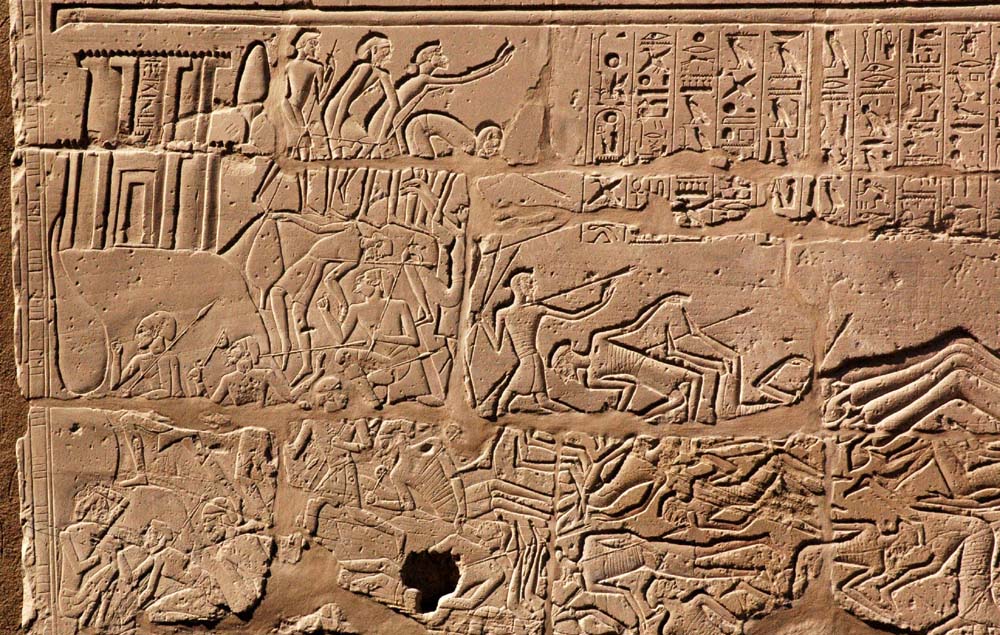
| Other inscriptions back up this connection of the Hebrews with specific Shasu tribes. For example there is a reference from a military campaign of the Egyptian Pharaoh Seti I which identifies the Apiru (Hebrews) and Shasu as being the same. |
| They are known as the Beth-Shan steles, both of which account the same military campaign of Seti I into the land of Israel during the first year of his reign. |
| The first stela states: "the foe belonging to the Shasu are plotting rebellion. Their tribal chiefs are gathered in one place, waiting on the mountain ranges of Kharu (Israel/Syria).” ANET 254(a) |
| Another inscription reads: "The desolation which the mighty arm of Pharaoh . . . made among the foe belonging to Shasu from the fortress of Sile to the Canaan." ANET 254(c) |
| The second BethShan Stela of Seti I, which records the same military campaign, states: |
| "The Apiru of Mount Yarmuta with Teyer have risen in attack upon the people of Rehem . . . His majesty commanded a certain number of soldiers from his infantry and his numerous chariots to turn their attention to the foreign country of Djahi." ANET 255 |
|
|
|
|
|
 |
|
|
|
|
|
|
|
|
|
|
|
| Djahi is the watershed country stretching from the Dead Sea north along the Lower Jordan to the sea of Galilee and then north along the upper Jordan river stretching as far north to the Orontes river, this was in the hands of Israel during their conquest of Canaan. |
| Yarmuta is the Biblical city of Jarmuth, and the region around it was in fact under the control of the Israelites according to Joshua 21:29. So this proves the Apiru were definitely one of the names the Egyptians used to refer to the Hebrews. |
| And since there is only one mountain range mentioned in the BethShan steles and that is Mount Yarmuta of the Apiru. The Apiru and Shasu in these inscriptions can be pretty well assumed as being the same enemy the Egyptians said they were fighting against. |
| Another Egyptian inscription from Pharaoh Amenhotep II also makes a connection between the Apiru and Shasu. At the end of his second Asiatic campaign, Amenhotep II erected a stele at Memphis on which he gave a list of booty he had collected, on which he lists the Apiru and Shasu side by side. It states: |
| “List of the plunder which his majesty carried off: Princes of Retenu (Syria): 127, Brothers of princes: 179, Apiru: 3,600, Shasu (Bedouin): 15,200.” (ANET 247) |
|
| GOD’S GREATEST WORDS TO ISRAEL |
|
| “And it shall come to pass, That whoever calls on the name of the Lord shall be saved. |
| "Men of Israel, hear these words: Jesus of Nazareth, a Man attested by God to you by miracles, wonders, and signs which God did through Him in your midst, as you yourselves also know; "Him, being delivered by the determined purpose and foreknowledge of God, you have taken by lawless hands, have crucified, and put to death; "whom God raised up, having loosed the pains of death, because it was not possible that He should be held by it. "For David says concerning Him: |
|
|
|
|
|
 |
|
|
|
|
|
|
|
|
|
|
|
| 'I foresaw the LORD always before my face, For He is at my right hand, that I may not be shaken. Therefore my heart rejoiced, and my tongue was glad; Moreover my flesh also will rest in hope. For You will not leave my soul in Hades, Nor will You allow Your Holy One to see corruption. You have made known to me the ways of life; You will make me full of joy in Your presence.' |
| "Men and brethren, let me speak freely to you of the patriarch David, that he is both dead and buried, and his tomb is with us to this day. "Therefore, being a prophet, and knowing that God had sworn with an oath to him that of the fruit of his body, according to the flesh, He would raise up the Christ to sit on his throne, "he, foreseeing this, spoke concerning the resurrection of the Christ, that His soul was not left in Hades, nor did His flesh see corruption. "This Jesus God has raised up, of which we are all witnesses. "Therefore being exalted to the right hand of God, and having received from the Father the promise of the Holy Spirit, He poured out this which you now see and hear. "For David did not ascend into the heavens, but he says himself: |
| 'The LORD said to my Lord, "Sit at My right hand, Till I make Your enemies Your footstool." ' |
| "Therefore let all the house of Israel know assuredly that God has made this Jesus, whom you crucified, both Lord and Christ." Now when they heard this, they were cut to the heart, and said to Peter and the rest of the apostles, "Men and brethren, what shall we do?" |
| Then Peter said to them, "Repent, and let every one of you be baptized in the name of Jesus Christ for the remission of sins; and you shall receive the gift of the Holy Spirit.” Acts 2:21-38 |
|
|
|
|
|
 |
|
|
|
|
|
|
|
|
|
|
|
|
|
|
|
 |
|
|
|
|
|
|
|
|
|
|
|
|
|
|
|
|
|
| This article is a chapter from our 3 volume book series "Bible Believer's Archaeology" which can be downloaded for your ebook reader or mobile device by visiting our resource download page by Clicking Here. |
|
|
|
|
|
|
|
|
|
|
|
|
| Photo Links to Artifacts Mentioned in this Article |
|
|
|
|
|
|
|
|
|
|
|
|
|
|
|
|
|
|
|
|
|
|
|
|
|
|
|
|
|
|
|
|
|
|
|
|
|
|
|
 |
|
|
|
|
|
|
|
|
|
|
|
|
|
|
|
|
|
|
|
|
|
|
|
|
 |
|
|
|
|
|
|
|
|
 |
|
|
|
|
|
|
|
|
|
|
|
|
|
|
|
|
 |
|
|
|
|
|
|
|
|
 |
|
|
|
|
|
|
|
|
|
|
|
|
| Merneptah Stele |
| Cairo Museum |
| JE 31408 |
|
|
|
|
|
|
|
|
|
|
| Thurmose III taking of Joppa mentions the Apiru |
| British Museum AE10060 |
| ANET 22 |
|
|
|
|
|
|
|
|
|
|
|
|
|
|
|
| Karnak Hypostyle wall relief |
| Seti I attack on Shasu |
| ANET 254 |
|
|
|
|
|
|
|
|
|
|
|
|
|
| Soleb Inscription |
| "Shasu of Yahweh" |
|
|
|
|
|
|
|
|
|
|
|
|
|
|
|
|
| Beth Shan Stele |
| Seti I attack on Apiru |
| Jerusalem Museum 885 |
| ANET 255 |
|
|
|
|
|
|
|
|
|
|
|
|
|
|
|
|
|
|
| Sources: |
|
| The Holy Bible, Author: The Lord God |
| Scripture taken from the New King James Version unless noted. |
|
| www.bible.ca - Merneptah stele - Israel section translation. |
|
| http://en.wikipedia/wiki/Merneptah_Stele (2009). |
| In 1896 Flinders Petrie located the stele at Thebes. The stela size is roughly 10 feet in height by 5 feet wide and is dated to 5th year of Merneptah (1209-1208 BC). |
|
| Ancient Near Eastern Texts - Relating to the Old Testament. |
| Author: James Pritchard: |
| ANET 276-278 - Merneptah Stele mentions Israel. Cairo Museum JE 31408 |
| ANET 22 - Thutmose III taking of Joppa, Mention of the “Apir.” British Museum AE10060 |
| ANET 246 - “List of his booty: . . . Canaanites: 640." |
| ANET 247 - “List of the plunder which his majesty carried off: Princes of Retenu (Syria): 127, Brothers of princes: 179, Apiru: 3600 , Shasu (Bedouin): 15,200. |
| ANET 254(a) states: "Year 1 . . . the foe belonging to the Shasu are plotting rebellion. |
| ANET 254 states: “foe belonging to Shasu from the fortress of Sile to the Canaan." Karnak Hypostyle wall relief Seti I |
| ANET 255 " states: "The Apiru of Mount Yarmuta with Teyer have risen in attack upon the Asaiatics of Rehem.” Yarmuta is Biblical Jarmuth. Beth Shan Stele |
| Jerusalem Museum 885 |
| ANET 242 Thutmose III inscription, list “Jacob-EL”, and “Joseph-EL..” |
| ANET 243 Rameses III inscription mentions “Levi-El.” |
| ANET 487 "May the king, my lord, know that the chief of the Apiru (Hebrew) has besieged the lands . . . it is only I and Abdu-Heba who fight against the ‘Apiru (Hebrew) chief.” Amarna letter #RA xix p.106. |
| ANET 259 mentions the "Shasu (Bedouin ) tribes of Edom", (reference Pritchard - Footnote 2. |
| ANET 262 - The Egyptians called the Edomites (the descendants of Israel's brother Esau) the "Shasu of Edom." |
| Summary of the Northern wars from Ramese III says: "I destroyed the people of Seir (main territory of the Edomites) among the Shasu (Bedouin tribes). |
| http://www.archaeowiki.org/Topographical_List,_First_Campaign_of_Thutmose_III |
|
| Actual List from Thutmose III Listing “Jacob-El” and “Joseph-El.” |
| Egypt, Trunk of the Tree By Simson Najovits, pg. 179-180: |
| Topographical List from Karnak. |
| Thutmoses III - Jacob-el, Joseph El, Shasu Springs. |
| Rameses II - Jacob-el, Joseph-el. |
| Rameses III - Jacob-el, Joseph-el, Levi-El, Asher. |
|
| The Shasu of Yahweh source: |
| Amenhotep III - 1386-1349 BC. Topographical List - 1386 BC. In the temple of Amon in Soleb there is a topographical list from the time of Amenhotep III (1408-1372 BC). In column IV. A2 is written” ssw yhw” which means "Yahweh of the land of the Shasu" (Giveon 1964, 244; Redford 1992, 272; Astour 1979, 17-34). In the ancient Near East a divine name was also was given to a geographical place where the god was worshiped (Axelsson 1987, 60). This is the first clear extra-biblical evidence of the name "Yahweh." |
|
| One name in the mentioned lists from Soleb and Amarah in Nubia Sudan - 'Yhw (in) the land of the Shasu.' |
| Shasu of Yahweh is a term that appears in Egyptian inscriptions of the 18th and 19th Dynasties (c. 1540-1190 B.C.). One, found at Amarah or Amrah in Upper Nubia, dates to the reign of Seti I (c. 1300 B.C.). An earlier inscription, probably from the reign of Amenhotep III (c. 1400 B.C.) was found at the Temple of Amun in Soleb, Sudan. |
|
| Artwork: “Merneptah inscription mentioning “Israel, the foreign people” based upon photo. Illustration © copyright 2009 John Argubright. |
|
| Artwork: “Inscription mentioning “Shasu of Yaweh” based upon photo” |
| Illustration © copyright 2009 John Argubright. |
|
|
|
|
|
|
|
|
|
|
|
|
|
|
|